
There’s a conversation happening in global Christianity that most Australian church planters aren’t part of. Not because they don’t care. Because nobody told them the room had moved.
What the Data Actually Shows
In 1910, the Global North – Europe, North America, Australia – was home to four times as many Christians as the Global South. Christianity felt like a Western religion because, statistically, it was.
That flipped around 1980. Most of us missed it.
By 2025, 69% of all Christians on earth live in Africa, Asia, and Latin America. Projected to reach 78% by 2050 (Center for the Study of Global Christianity, 2025). Africa is now the most Christian continent on earth. Over 750 million believers. Growing at 2.59% per year. Europe’s church is contracting. North America too.
Philip Jenkins mapped this in 2002 in The Next Christendom. He argued the Global South would eventually send missionaries back to re-evangelise a secularising West. Most Western church leaders treated it as an interesting theory.
It isn’t a theory anymore. It’s Tuesday.
This Isn’t Abstract
I grew up across Southeast Asia – Myanmar, Thailand, the Philippines, Hong Kong. My father was a missionary. I spent my twenties on the Thai-Burma border doing crisis response, leading teams into some of the most spiritually alive, resource-poor communities I’ve ever encountered.
That shaped everything about how I see the church.
For the last decade I’ve been CEO of Online Bible College, the ministry my father founded in 1998. We serve 70,000 students across 190 countries. Tuition-free. Because Matthew 10:8 says freely give, and we take that seriously.
I’ve sat with pastors in Yangon leading hundreds of students on a budget that wouldn’t cover a single semester at an Australian seminary. The faith in those communities doesn’t look like it’s trying to survive. It’s multiplying.
That same faith is now in your city.
Australian Christian affiliation dropped from 61% to 44% in a single decade (ABS Census, 2021). Weekly attendance is 4.6% of the population. We lost 800 congregations between 2016 and 2021 (NCLS, 2024). Those numbers are real.
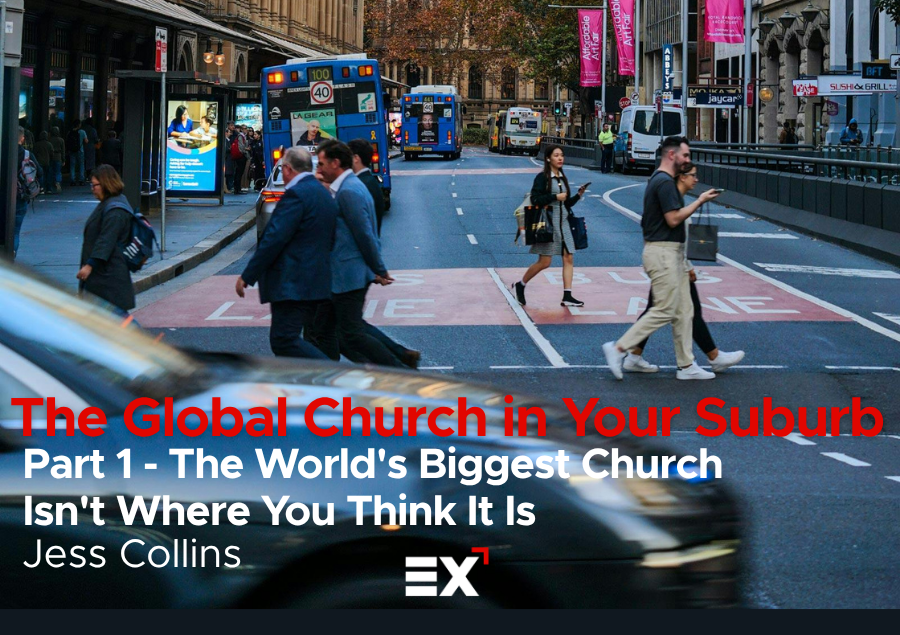
But step outside the census and walk your suburb. The communities driving the fastest Christian growth on earth – Nigerian, Filipino, Korean, Indian, Sri Lankan, Pacific Islander – aren’t a mission field you need to fly to. They’re in Blacktown, Parramatta, Dandenong, and Marsden Park. Already gathered. Often already planting.
The mission force and the mission field are in the same postcode.
The Question We’re Not Asking
Most Australian planting models were built for an Anglo, post-Christian context. That context still exists. But it describes a shrinking proportion of the people around our church plants – and it assumes a single cultural framework for how people hear the gospel.
That’s the problem.
Missiologists Jayson Georges, Roland Muller, and Jackson Wu have each argued that the gospel speaks across three primary cultural frameworks: guilt and innocence, shame and honour, and fear and power. Western Christianity has defaulted almost entirely to the first. Most of our Global South neighbours process identity, sin, and salvation through the second or third.
I’ve seen it firsthand. A student in Myanmar hears the cross as the Father absorbing ultimate public shame so his son doesn’t have to walk the gauntlet alone. That’s not a lesser gospel. That’s Luke 15 read by someone who actually lives in an honour culture.
If our plants only speak one language, we’ll keep building churches a huge portion of our city can’t hear. Not because they’re resistant. Because we’re not speaking to them.
And there’s a posture question worth naming. For generations the assumption has been that we resource them. But the spiritual vitality of the global church now largely lives with the communities we’ve historically positioned ourselves above. The pastor from Lagos planting in Blacktown isn’t a recipient of our mission strategy. In many cases, he’s ahead of it.
The decline story about the Australian church is real. But it’s incomplete.
The global church isn’t shrinking. It’s moving. And it’s moved right into our neighbourhoods.
The only question is whether we’ll plant for the city we imagine – or the city we’re actually in.
Next: Part 2 – We’ve Been Preaching One Third of the Gospel.