
making disciples
The Church in Australia has traditionally focused on discipleship rather than making disciples.
This is a critical difference that has significant ramifications, but many of us truly don’t understand why the two are so different with such different outcomes.
If we want to make Jesus’ Great Commission, His last command to us our first priority, then the difference between “discipleship” and “making disciples” needs to be clearly understood and our current practices evaluated to ascertain not only the difference, but what shifts need to be made to bring our intent and practices into line with Jesus instruction to us.
Peyton Jones in his Exponential book “Discipology: The Art and Science of Making Disciples” articulates the difference this way.
If Jesus had commanded us to focus on discipleship instead of disciple-making, the Great Commission might have sounded like this:
Instead of “Go” Stay where you are. Build community and gather regularly. Keep things steady and consistent.
Instead of “to all nations” Stick with your own kind—people who are like you; your small group, your church family, familiar faces, and shared experiences.
Instead of “baptizing them” Invite them to a group, class, or gathering. Offer a safe place to learn. Let growth happen slowly over time.
Instead of “teaching them to obey” Encourage personal growth. Focus on becoming more Christlike, developing character, and growing in faith; learn truth from Scripture, deepen understanding, and build spiritual habits.
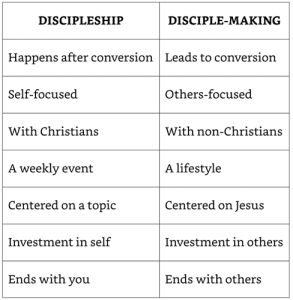
Peyton also summarises the difference in the following table:
Let’s be frank; it’s challenging! It’s much safer working with the 99 than the 1 who isn’t in the flock! But that’s where Jesus commands us to be – and what He commands us to do.
As Peyton says in his Exponential publication “Journey to Disciple Making”, a 28 session guide to implementing Discipology principles,
“We tend to make disciples in the same way we were discipled. And if that’s true, the flip side is also true: we tend to not make disciples in the way we were not discipled.
Peyton unpacks three keys to disciple making.
- Teaching. That’s where we learn information that may be useful in growing and maturing as a Jesus follower. Weekend services major on providing teaching. But information by itself rarely brings transformation
- Time. Small groups are great at providing a relational space where people can not only process the information they have learnt but discuss it with others. This is when information supplemented by time can lead to transformation happening.
Many churches in our nation excel at the teaching and time that lead to information and transformation. But they all too often fall short of the third key which is:
- Tactics. That’s a word for doing something with what you have learnt; bringing activation to the party so that we not only gather information and undergo personal transformation, but we experience activation where we do something about it. Jesus’ words in Luke 10:3 come to mind. “Go! I am sending you out…”. Not sit around and discuss, or get more information, but go and apply what you have learnt and digested.
That’s the challenge of making disciples; obeying the commands of Jesus to do so.
In “Discipology: The Art and Science of Making Disciples” Peyton defines the difference this way.
Discipleship: The ongoing process of developing as a Jesus follower. Discipleship happens after conversion and is the process of maturing spiritually in the faith—learning to become more like Christ through practices like prayer, Bible study, and fellowship with other believers. It is spiritual growth.
Disciple-making: The intentional process of helping others become followers of Jesus. Making disciples involves evangelistically guiding others to follow Jesus in a proactive mobilization effort that multiplies disciples.
There is no doubt that the Church in our Nation needs more disciple makers.
I think that Peyton is correct when he writes that “we tend to make disciples in the same way we were discipled. And if that’s true, the flip side is also true: we tend to not make disciples in the way we were not discipled”.
To progress along the journey to becoming a disciple maker, I highly recommend the following four resources:
- Discipology: The Art and Science of Making Disciples by Peyton Jones
- Journey to Disciple-Making: A Discipology Journal (Exponential Series) by Peyton Jones
- The 10 Shifts to Birth Disciple Making Multiplicationebook available free from Exponential Australia, and
- Multiplier by Dave Ferguson, a great book that will help you to Make Disciple Makers, Establish Spiritual Communities, Mobilise Leaders and Launch Church Expressions.