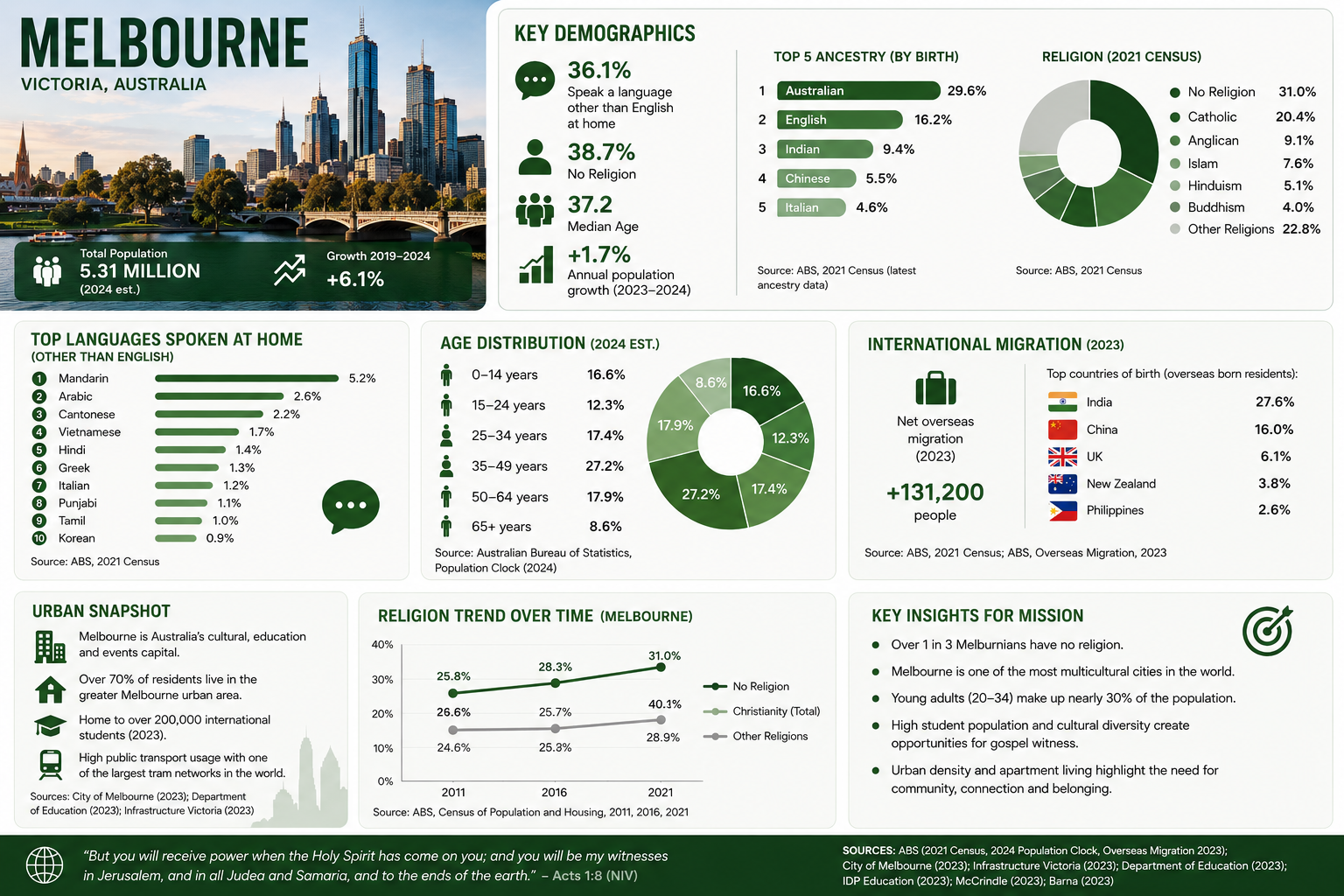

Australia is experiencing rapid growth across all major cities. This is no surprise. However, what may interest you is the steady rise in those stating ‘No Religion’, increasingly diverse populations, the age demographic comprising mostly of young adults (20–39), and Hinduism and Islam as the leading religions after ‘No Religion’ and Christianity. Additionally, Mandarin is the most spoken language after English in every major city in Australia.[1]
My question is: Are we creating spaces that meet the needs of these people?
According to Charles Taylor, the secular age is “believing otherwise”, rather than disbelief.[2] Julian Barnes summarises this by stating, “I don’t believe in God, but I miss Him.” The World Values Survey ranks Australia as the sixth most secular country in the world.[3]
However, religion is not dead.
68% of Australians follow a religion or have spiritual beliefs.[4] Gary Bouma says Australians have a “spiritual shyness” and “an allergy to organised religion.” We tend to hold our spirituality in our hearts and speak “tentatively” about it.[5]
What is this doing to the emerging generation?
Australian teens, in comparison to global teens, are less optimistic, less confident, feel they have little influence in their communities, are less trusting of Jesus, and are more sceptical about the Bible.[6] The one area where Australian teens fare better is emotional health. Those in the church are frustrated with generational conflict and place significant trust in their parents when it comes to learning about faith, highlighting just how vital family ministry is.
The reality for Gen Z in Australia is that one in five have spiritual beliefs, the number one blocker to Christianity is the church’s stance on homosexuality, and 77% believe social media is an appropriate space to talk about religion. Yet this generation is also the most likely to have NEVER heard about Jesus.[7]
Are we showing up in the spaces that are important to these people? Or just the spaces that are important to us?
This is our opportunity!
Young people are open to spiritual conversations… they just have less trust in the local church.
So, what would it take to be bold?
It might simply start with a conversation.
How wildly outrageous is that!
Authentic community is what Australians and young people are craving. Non-religious Australians are open to church attendance if they find a community with similar values that provides comfort in times of trouble.[8] If that’s not a church, a community of believers, I don’t know what is.
If you need help starting, the top three elements of thriving communities are:
- Laughing often and having fun together
- Ease of conversation
- Being inclusive and accepting of others
And love is the attribute of Jesus Australians connect with most.[9] After all, “the greatest of these is love.”[10]
Authentic community and intergenerational connection are some of the strongest assets we have for keeping the next generation connected.
Furthermore, authenticity grows when leaders stop pretending they have it all together.
Young people need spaces where questions are safe, relationships are genuine, and discipleship is embodied.
Many young adults don’t ask first, “Is Christianity true?”
They ask: “Do I belong?” “Will someone know me?” “Is there hope?” “Does my life matter?”
If we can create spaces where young people can wrestle with these questions alongside us, we have an opportunity to reach the Next Generation.
[1] See the infographics at the end of this article for more information.
[2] Charles Taylor, A Secular Age (Cambridge, MA: Harvard University Press, 2007), 53.
[3] Ryan Burge, “What Countries Are the Most Religious? Which Ones Are The Least? Wave 7 of the World
Values Survey Gives Us Insight into Religion in 64 Countries,” Religion in Public, December 18, 2023.
[4] McCrindle Research, Faith and Belief in Australia (Sydney: McCrindle Research, 2022), 9.
[5] Gary Bouma, Australian Soul: Religion and Spirituality in the 21st Century (Cambridge: Cambridge
University Press, 2006), 2.
[6] Barna Group, The Open Generation: A Global Teen Study (Ventura, CA: Barna Group, 2022), 8–10, 14, 17.
[7] McCrindle Research, The Changing Faith Landscape in Australia, 14, 21, 35, 38; Barna Group, The Open Generation, 11.
[8] Christian Research Association, Pointers 32-2e: Religious and Spiritual Nominals, Volume 32, no. 2 (June 2022): 5.
[9] McCrindle Research, Faith and Belief in Australia, 10.
[10] 1 Corinthians 13:1.
Infographics
(Click to expand)