
church multiplication
There is no doubt that God’s plan for us involves multiplication. In Genesis 1 and 9 we see the repeated command to be fruitful and multiply. The ESV Translation tells us in Acts that the number of disciples multiplied (Acts 6:7) and the church also multiplied (Acts 9:31)
So how are we doing in Australia at seeing church multiplication becoming the norm? What are the major blockages to overcome and what are some steps that we can put in place to see multiplication become common?
The State of the Church in Australia
Exponential Australia commissioned NCLS Research the Report “Growth, decline, and planting by Australian churches” which drew upon results from the 2021 National Church Life Survey.
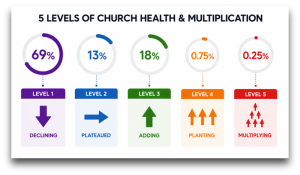
The Report segmented churches across our Nation into the following five categories and found that:
- Level 1 – 69% of Australian churches had declined by 10% or more in the 5 years to 2021,
- Level 2 – 13% had plateaued
- Level 3 – 18% had grown by addition,
- Level 4 – 5% had planted over the period with 0.75% in planting in 2019.
- Level 5 – only 0.25% of Australian churches were estimated to be multiplying in 2019
NCLS will provide an update on these figures after the 2026 church survey has been completed.
5 Reasons Why the Church Multiplication Rate Is So Low
1. The Operating System Focuses on Adding Only
The operating system in many churches focuses on attendance, attraction, and centralised ministry activity, but it often struggles to reproduce disciples who can disciple others. As a result, churches may grow larger without becoming more reproductive. When success is measured primarily by seating capacity, budgets, and weekend participation, multiplication naturally becomes secondary.
The New Testament pattern, however, was not simply gathering crowds but equipping ordinary believers to live missionally and reproduce faith in others. It was a pattern of growing as a result of multiplying disciples as well as adding them. A healthy church should have both.
2. The Level 3 Magnet is Strong
Many churches unintentionally become “Level 3” churches that are healthy enough to attract people and sustain programs, but not committed enough to multiplication to release leaders and plant new works. The comfort of stability, predictable growth, and established systems creates a powerful pull to stay where things are manageable and successful and to invest further in these with any available people or financial resources.
Multiplication, however, requires risk, sacrifice, and sending some of your best people away. Without a deliberate commitment to reproduce disciples, leaders, and churches, the natural tendency is to settle into maintaining and growing what exists rather than investing in multiplication.
3. We Aren’t Good At Making Disciples
Effective disciple making requires a shift in the operating system of many churches. Preaching is a powerful and necessary part of many churches. But we need more than good preaching to make disciples. There’s a saying that “preaching adds but disciple making multiples”.
Effective disciple making relies on relationships and not just programs. As Peyton Jones writes in “Discipology: The Art and Science of Making Disciples”, Jesus made disciples using each of the following three components:
- Time – when He relationally connected
- Teaching – where He taught, and
- Tactics – where He activated and deployed the disciples to do what had been taught.
4. We Are Slow to Send
Jesus made it clear that the problem isn’t in the harvest. It’s plentiful, ready and waiting. The problem to be overcome is sending workers into the harvest. This requires preparing people to be workers then giving them away by sending them out. To be intentional about doing this we need to have equipping pathways in place; leadership pipelines that raise up church planters and their teams.
Sometimes we convince ourselves that people aren’t yet ready when they quite likely are. In “Discipology: The Art and Science of Making Disciples”, Peyton Jones makes the observation that we often wait until a person is confident when the real issue is that they need courage rather than confidence. He writes that the disciples that Jesus called were likely only 15 to 18 years old when He called them. And on the day of Pentecost, when a church of 3,000 was born they would have been only 18 to 21 years old! In Jesus eyes these young men were ready to be sent into the harvest.
5. There Has Been Resistance to New Models of Church
Frequently, when wishing to plant a new church, leaders continue to rely on traditional models that were designed for a different cultural moment. While these approaches may still serve some people well, resistance to experimenting with simpler, more reproducible forms of church has slowed multiplication.
New models often feel risky yet multiplication usually happens through adaptable, relational, and mission-focused expressions of church that can easily reproduce in different contexts. When innovation is resisted, reproduction becomes difficult, limiting the church’s capacity to multiply.
Another aspect is that potential multipliers might look at the large, established church already in place and can’t imagine themselves ever leading (or perhaps wanting to lead) a church like that. Perhaps they don’t realise that church doesn’t have to follow that pattern and that innovation may open the way for a new and different expression of church?
Our Nation Needs Church Multiplication
Across our Nation there are many water storage dams. They collect water and store it. But they aren’t useful until that water is then distributed to irrigate the soil and play a critical part in bringing life to the otherwise dry and barren places.
In a way, churches are like that also. They can collect people and be filled to the brim, but our Nation needs them to send out workers and new churches into the harvest, multiplying as they go.
Whenever I think of this, the following passage from Isaiah 43:18-21 (NIV) comes to mind:
“Forget the former things; do not dwell on the past. See, I am doing a new thing!
Now it springs up; do you not perceive it?
I am making a way in the wilderness and streams in the wasteland.
The wild animals honor me, the jackals and the owls, because I provide water in the wilderness and streams in the wasteland, to give drink to my people, my chosen, the people I formed for myself that they may proclaim my praise.”
Our Nation needs to see multiplication of disciples, leaders and churches not only put on the agenda but become the norm. And it will take courage to do new things.